How Saleoid Lets Small Businesses Build Their CRM Around What They Actually Need
Sep 16, 2026
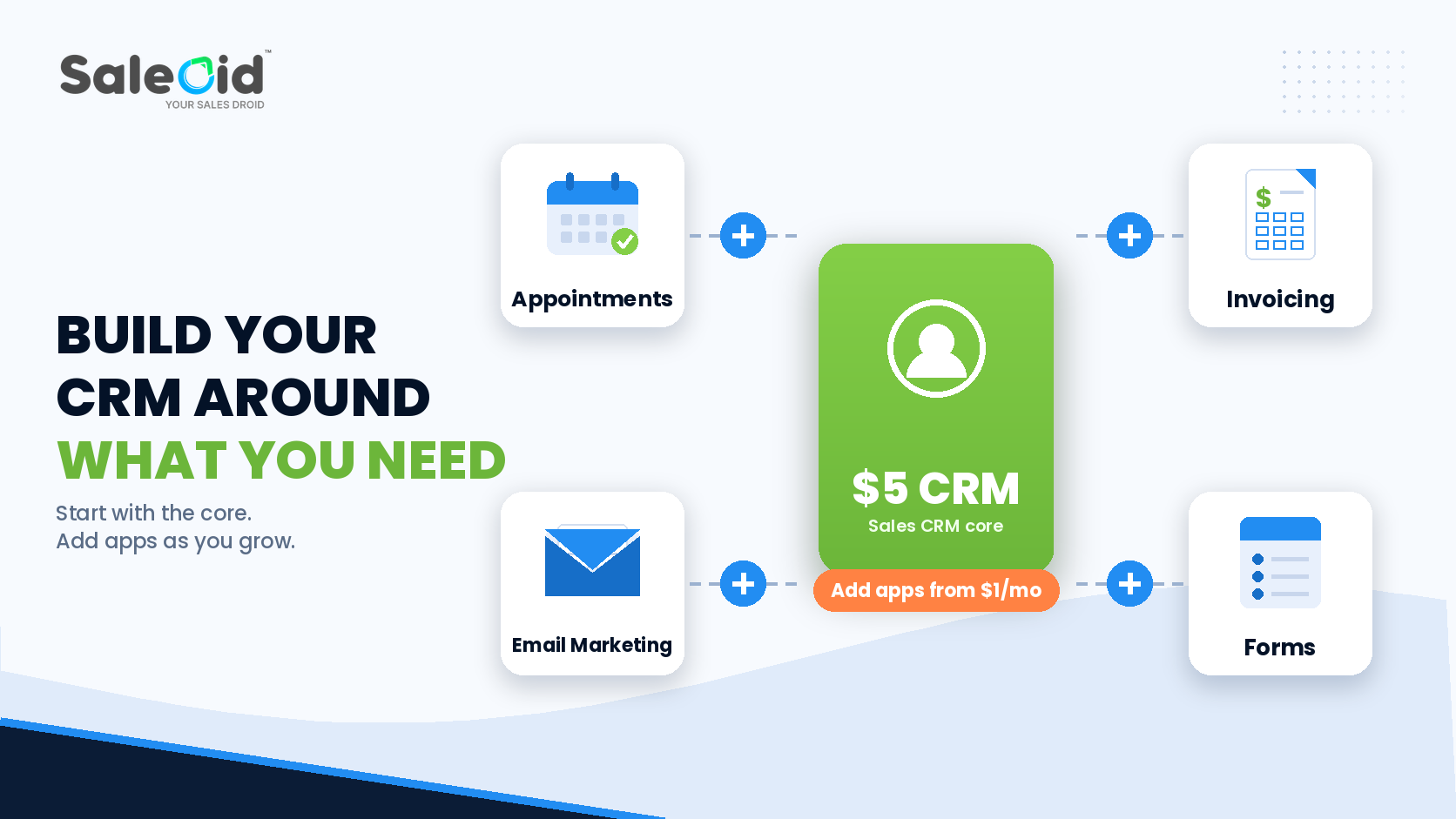
Instead of forcing every business to buy the same software bundle, Saleoid allows small teams to start with a $5 Sales CRM and add applications according to how they sell, communicate and serve customers.
Boca Raton, Florida Sep 15, 2026 (Issuewire.com) - Most small businesses know they need a better way to organize leads, customers and follow-ups. What they do not always need is a large software package containing dozens of applications from the first day.
A consultant may need contacts, appointments, agreements and invoicing. An agency may care more about pipelines, forms, landing pages and email marketing. A subscription business may need plans, recurring billing and customer communication. A small sales team may simply want one reliable place to manage leads and know who needs attention next. These businesses all need CRM software, but they do not need the same CRM.
Saleoid $5 AI CRM addresses that difference with a build-your-own approach. Businesses can begin with the platform's Sales CRM and then add applications based on their current requirements. This allows them to create a connected business system without paying for a large collection of tools they may not use.
The Saleoid Custom Plan starts at $5 per month when billed every two years. Additional business applications start at $1 per app per month. Businesses that prefer a complete, ready-made collection of tools can instead select one of Saleoid's prebuilt plans. The idea behind this model is straightforward: the software should adjust to the business, rather than forcing the business to adjust to a fixed software package.
Small Businesses Rarely Need the Same CRM Setup
The phrase "small business" includes a wide range of organizations. A solo consultant, a 5-person agency, a growing sales team and a local service company may have a similar number of employees, but the way they manage customers can be completely different. The consultant may begin with a small number of high-value prospects and need a simple way to schedule meetings, send agreements and issue invoices.
The agency may collect leads through landing pages and forms, manage several sales pipelines and run email campaigns. The service business may care about bookings, estimates, payments and regular customer communication. The growing sales team may need lead scoring, permissions, follow-up tasks and better visibility across multiple users.
A conventional CRM package often gives all of these businesses the same set of features. The company then has to ignore what it does not need, configure what it can use and pay for the complete plan regardless. Saleoid takes a different approach to CRM for small businesses. It gives companies a working CRM foundation and lets them decide which additional capabilities belong in their setup.
"Small businesses should not have to buy software for the company they might become three years from now," said Vivek Sharma, Founder of Saleoid and EQUP Inc. "They should be able to start with what helps them today, add more when the need becomes real and keep everything connected as the business grows."
What Businesses Receive With the $5 Sales CRM
Saleoid's Custom Plan begins with the core Sales CRM. The plan is designed to provide a useful customer management foundation before a business selects any additional applications. The Sales CRM includes tools for customer engagement, lead scoring, team roles and permissions, dashboards, filters, email verification, email tracking, scheduling, tasks, notes and notifications.
It also includes a complete customer view that helps users see customer information and activity in one place. Businesses can manage up to 2,500 contacts and companies, create five automations and maintain automation history. The $5 plan includes one user, with additional users available at $6 per user. It also includes three accounts, consisting of one main account and two subaccounts.
This means a business can begin by organizing its customer information, tracking activity and managing follow-ups before deciding whether it also needs marketing, appointments, billing or other operational tools. For some businesses, that foundation may be enough at the beginning. Others can use it as the starting point for a more complete setup.
Applications Can Be Added When the Workflow Requires Them
Saleoid's custom CRM pricing plan allows businesses to add applications individually. Available options include landing pages, forms, appointments, invoicing, services and products, email marketing, SMS marketing, WhatsApp marketing, social media management, pipeline deals, plans and subscriptions, agreements, customer engagements, bookings, online payments, estimates and quotes.
Many of these applications start at $1 per month under two-year billing. More specialized options, including API access, white-label functionality and dedicated support resources, have separate prices. The purpose is not to encourage a business to add every application. It is to let the business select the parts that solve an actual requirement.
A consultant could add appointments when manual scheduling becomes difficult. Agreements could be added when proposals begin turning into formal client relationships. Invoicing could be introduced when the consultant wants customer and payment information connected.
An agency could begin with CRM and pipeline management, then add forms and landing pages when it starts running lead-generation campaigns. Email marketing and social media tools could be added when the agency wants outreach and customer information managed from the same platform.
A subscription business could add plans and subscriptions without purchasing unrelated applications for bookings or estimates. The software expands according to the workflow instead of requiring the business to predict every future requirement during signup.
Building a CRM Does Not Mean Connecting Unrelated Tools
Many businesses already follow a form of "build your own" software strategy, although they may not describe it that way. They select one tool for contacts, another for email marketing, another for scheduling and another for invoicing. Each tool may solve one problem well, but the business is left responsible for connecting them.
Customer information may be copied manually between systems. Employees may have to search several applications before understanding what has happened with a lead. A change made in one tool may not appear in another. Each application has its own login, billing cycle, interface and support process.
Saleoid's approach is different because the selected applications operate within one connected platform. When a business adds appointments, forms, invoicing or email marketing, it is extending the same customer management environment. The goal is to keep customer information, communication and business activity connected rather than creating another collection of isolated subscriptions.
This distinction matters for small teams. Flexibility should not require fragmentation. A business should be able to choose what it needs without losing the benefits of a shared customer record and connected daily workflow.
Clearer CRM Pricing Starts With Understanding the Complete Requirement
A low starting price is only useful when a business understands what that price includes and what will cost extra. Saleoid presents 2 main ways to purchase the platform.
The first is the Custom Plan. It starts with Sales CRM at $5 per month under two-year billing. The plan includes one user, and additional users cost $6 each. Optional applications can then be added individually.
The second option is a prebuilt business suite. These plans start at $19 per month with two-year billing and include a prepared collection of CRM, marketing, billing and business management applications. They also include different user allowances and usage limits.
If the applications selected through the Custom Plan would make a bundle more economical, Saleoid can recommend the relevant prebuilt plan before checkout. This gives businesses a choice between control and convenience.
A company with a focused requirement may find the Custom Plan more suitable because it can select a small number of applications. A team that already knows it needs CRM, marketing automation, billing, appointments and other connected tools may find a prebuilt plan easier and more economical.
"Pricing should help a business make a clear decision," Sharma said. "A company should understand what it receives, what it can add and when a bundle becomes the better option. The goal is not to keep a business on one type of plan. The goal is to help it choose the setup that makes sense."
A CRM Can Change Without Forcing a Complete Migration
Small-business requirements rarely remain fixed. A founder may initially manage every lead personally. As the company grows, another salesperson may join. The team may begin running email campaigns, accepting online appointments or sending regular estimates and invoices.
With a fixed software package, growth often creates one of 2 problems. The business may have purchased too much software at the beginning and paid for unused features for months. Alternatively, it may have selected a limited plan and later discovered that adding one important capability requires moving to a much more expensive tier.
Saleoid's modular model provides another route. Businesses can add applications to the existing CRM as new requirements appear. If a ready-made bundle becomes more practical, they can switch between the Custom Plan and a prebuilt plan. This allows the CRM to change without requiring the company to replace the entire system simply because its workflow has developed.
The approach is particularly relevant for startups, consultants, agencies and owner-led businesses. These companies often know what they need today, but their processes may change quickly as they gain customers, hire employees or introduce new services.
AI Should Be Added Where It Makes Work Easier
The same principle applies to AI. Small businesses do not necessarily need every part of their software to be presented as an AI feature. They need AI in the places where it can reduce repetitive work, improve clarity or help the team respond more consistently.
Saleoid's AI CRM for small businesses is designed to support areas such as lead management, follow-ups, communication, scheduling, marketing and customer activity. AI-assisted capabilities are available across relevant parts of the platform, including email marketing, WhatsApp marketing, appointments, estimates, agreements, landing pages and chatbots.
A business can select the applications connected to its workflow instead of purchasing a large AI package simply because it is included in a higher tier. For a consultant, useful AI may mean assistance with follow-up communication and appointments. For an agency, it may support campaign content and lead engagement. For a growing sales team, it may help identify customer activity that requires attention.
The value comes from applying AI to a real task, not from adding another label to the software.
Custom Plans and Prebuilt Plans Serve Different Businesses
The build-your-own model is not intended to suggest that every company should create its plan application by application. Some businesses already know they need a broad set of connected tools. They may want CRM, marketing automation, billing, appointments, projects, agreements and communication ready from the beginning. For these companies, a prebuilt plan can provide faster setup and clearer overall pricing.
Other businesses have narrower requirements. They may want customer management, follow-ups and invoicing but have no need for landing pages, social media management or subscription billing. An affordable CRM pricing plan gives them greater control. Neither option is automatically better.
The right decision depends on:
- What the business needs to accomplish now
- How many employees require access
- Which customer processes need to remain connected
- Whether the company prefers individual applications or a prepared suite
- How quickly its requirements are expected to change
- Which billing term fits its budget and plans
Saleoid allows businesses to compare both routes rather than forcing every customer into the same purchasing model.
Starting Small Should Not Mean Staying Limited
There is an important difference between starting with less and being restricted to less. A small business may begin with basic customer management because that is the immediate priority. That does not mean it will never need automated marketing, appointments, agreements, subscriptions or online payments.
Saleoid allows the first decision to remain small without limiting the business's future options. The company can begin with the Sales CRM, learn which processes need improvement and expand the platform based on real experience. This can produce a more relevant setup than selecting a large bundle before the team understands which applications it will actually use.
It can also make software decisions easier for employees. Instead of introducing many applications at once, a business can establish the CRM foundation and add new capabilities when the team is ready to use them. The result is a platform that can remain focused during the early stages and become broader when the business requires more support.
Putting the Business Before the Bundle
Saleoid's build-your-own model is based on a simple observation: small businesses should not have to purchase identical software packages when they operate in different ways. A useful CRM should reflect the business's customers, team, sales process and daily responsibilities. It should give the company a clear starting point, make additional capabilities available and keep those capabilities connected.
Saleoid is an AI CRM from EQUP Inc., with product roots dating back to 2013. After years of developing custom software solutions for businesses and enterprise organizations, EQUP Inc. made the current AI-powered Saleoid platform broadly available in 2025, giving small businesses access to affordable, practical business management software.
Its Custom Plan gives small businesses direct control over which applications they add. Its prebuilt plans offer a faster route for teams that already need a broader business suite. Together, the two options allow companies to choose software based on how they actually work rather than the contents of a fixed bundle.
Businesses can explore Saleoid with a 15-day free trial and compare the Custom Plan with available prebuilt plans before subscribing.
Source :Saleoid
This article was originally published by IssueWire. Read the original article here.
More News




























Recommended
YOUR NEWS, OUR NETWORK.
Do you have Great News you want to tell the world?
Be it updates about your business or your community, you can make sure that it’s heard by submitting your story to our network reaching hundreds of news sites across 6 verticals.